Saturday, September 29, 2018


Thursday, September 26, 2013
Update
History of Pakistan will be shifting to another domain after an indefinite time period. Due to Google's enforced change of blogspot's new and
more difficult layout, I will be forced to switch domains.
Readers will be notified here when this blog has been shifted with the link to the new blog page. The current posts from this blog page will also be found in the new blog. Also due to real life issues I cannot guarantee when this will happen. Apologies to readers for this inconvenience.
Readers will be notified here when this blog has been shifted with the link to the new blog page. The current posts from this blog page will also be found in the new blog. Also due to real life issues I cannot guarantee when this will happen. Apologies to readers for this inconvenience.
Sunday, August 21, 2011
The falsified myths of Greek and Macedonian roots of Northern Pakistani populations.
The Kalash and Hunza are amongst the fairest people in Pakistan. Even their hair can be blond, brown or red with blue or green eyes.
And because of their remote location, many of them still follow non-Muslim cults and spiritualities such as those derived from ancient Indo-European paganism. There are also few there who practice Shamanism.
Other spiritualities have died out or have been embedded into Islam such as Sufism.
Physical appearance evidence:
Because of their fair features and some of them retaining non-Muslim practices, many myths of their alleged "Greek" and "Macedonian" ancestry have arisen.
This myth may have started out as far back as the British Raj, but forgotten and later revived perhaps as recently as the mid 90s by missionaries from Greece and Macedonia.
Many recent documentaries and articles are made by Greek and Macedonian missionaries who go and pressure the Kalash and Hunza to accept descent from Alexander and his army.
They also offer financial aid in return for accepting the theories of their alleged Greek/Macedonian origins.
At other times, they manipulate these populations (sometimes even the Pakhtuns) into believing they are of Alexander's army. Part of this is due to the struggle between Greece and the modern country of "Macedonia" (better known as republic of Macedonia) to claim Alexander The Great as one of them.
And as already mentioned, because the Kalash and Hunza have certain traits mostly different from the rest of modern Pakistan, these have been used as a claim to declare them as "Greeks" or "Macedonians."
White features (light skin, hair, eyes etc.) are not a trait uncommon in Pakistan.
There are hundreds of thousands, perhaps millions of people from Pakistan with white skin (including those in my family) and features similar to Mediterranean peoples and some to central and Northern Europeans.
What is now uncommon, especially in modern times is Nordic features in Pakistan.
On the subject of of skin and hair colors, it should be noted that most Greek people have much darker hair and sometimes darker skin than the Kalash and Hunza.
In fact, many people from central and western Pakistan can be better compared in hair, eye and skin color to Greeks.
Here is a random picture of Greek people dancing:

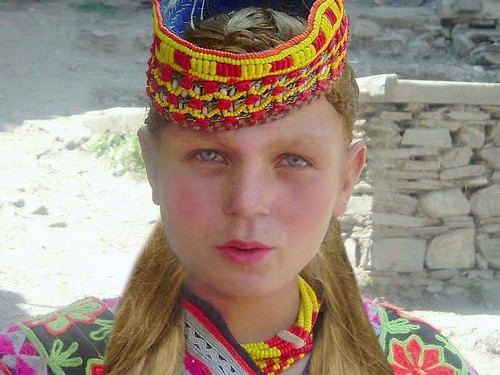
Now compare them to Northern Pakistanis, mainly unmixed Kalash and Hunza pictures below. (click on images to enlarge)
White Northern Pakistani girl of unknown ethnicity:

Kalash:


Though many or most Kalash may look Mediterranean (unlike the pictures above), the reason behind that might be absorbing genes from other darker-skinned populations in the regions.
Percentage wise I would say the more pure unmixed Kalash have lighter skin and hair than modern Greeks.
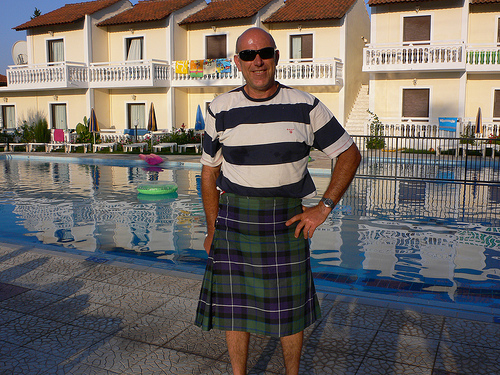
I would say the same in the case of the Hunza. Take another example of this Greek man and compare him to some fairer Hunza:

Hunza:


Evidence of religion/spirituality:
Moving on to the religious past, most Pakistanis are blind to the history and practices of their ancient ancestors; hence they are often prone to Hindutva propaganda, which speaks of a "religion" called "Hinduism" being practiced in Pakistan (see meanings and origins of Hinduism) prior to Islam.
The blindness of Pakistanis to the history of their ancient ancestors is amplified by Wahhabi Islamists who teach them that their ancestors were victims of a caste system and practiced barbaric traditions. At other times they are taught that their ancestors were Arabs, Turks and Persian.
Actually the reality is far from the teachings of the Islamists.
The people of Pakistan, being primarily of Indo-European (IE) descent had ancestors who practiced various related IE cults and religions.
The same is the case for modern Europeans who have common ancestry with the people of Pakistan, especially Northern Pakistanis, who live in remote, mountainous locations and have absorbed much less non-Indo-European genes due to their isolation.
These common ancestors of Pakistanis and Europeans were called the Proto-Indo-Europeans.
A fact to note is that not all people who speak an IE language are descended from the Proto-Indo-Europeans.
The early IE people lived sometime around the fifth or sixth millennium BC. They had many pagan gods and symbols in their paganist cults/religions. To understand them better, readers should research ancient Indo-European culture, spirituality and mythology.
Some good resources for these are Internet sites such as this or books such as Encyclopedia of Indo-European culture.
After centuries of IE migration and the rise of major world religions such as Buddhism, Christianity, Islam etc, the various related spiritualities of the IE people began to die out to these major world religions.
However, traces of these spiritualities and mythologies can still be found in various IE ethnic groups, which can be very similar to each other, establishing another common connection between IE peoples besides language.
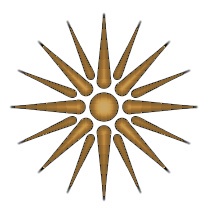
Take for example the Greek sun pictured below:

Now compare it to the sun on the flag used by the Kurdish people:

As readers can see, these symbols are used by two peoples, Greeks and Kurds, both speaking IE languages.
The strong resemblance is not a coincidence as the two suns have a common source in IE mythology and culture.
In the case of the Kalash, their IE religion did not die out to Islam or any other due to their extremely remote location.
Anthropological and historical material claims their religion/cult to be a direct off-shoot of the original IE religion(s).
Because most of the people of Pakistan no longer practice IE culture or spirituality, some Greeks and Macedonians have tried to claim the Kalash peoples as their own.
Their methods seem to be by pointing to the common IE culture and spirituality of the Kalash to Greece and Macedonia's pre-Christian IE cultural and spiritual traits.
By this reasoning, the Greeks and Macedonians can also claim other IE practices and cultural traits to be from Alexander's armies.
Take for example Celtic culture or Zoroastrian culture.
Look at the sun in this Zoroastrian depiction below:

Does it not look similar to the Greek sun pictured further up in this post? Can Greeks and Macedonians now claim the Zoroastrian peoples in the region to be Alexander's descendants?
Or even the Kurds. Can the Kurds be claimed to be Alexander's descendants based on the common sun symbol between the Greeks/Macedonians and them?
The point I'm trying to make is that the culture and religion of the Kalash does not resemble pre-Christian Greek or Macedonian culture because the Kalash are an "off-shoot" of Alexander's army, but due to a common origin between the cultures of pre-Christian/Muslim/Buddhist etc. cultures and religions of IE peoples- including the pre-Islamic ancestors of most Pakistanis.
Linguistic evidence:
Greek and Macedonian are both IE languages. Greek is an isolated language in the IE family belonging to the Centum sect, while Macedonian is a Slavic language belonging to the Satem sect.
The language of the Kalash on the other hand belongs to the Dardic branch of IE. Linguists sometimes place Dardic as part of Indo-Aryan, but a distinct form of Indo-Aryan or "Northern Indo-Aryan."
To claim the Kalash as one of theirs, Greeks and Macedonians would have to explain how a Greek/Slavic speaking people, switched to Dardic. Some would possibly argue it is due to being surrounded by Dardic speaking populations.
Though I might be wrong, sources I've come across have indicated that language shift usually leaves traces of the previous language of an ethnic group in the new language that they have adopted.
Outside of a common Proto-Indo-European (PIE) source, can any traces of Slavic or Greek words be found in Kalashamondr? If so is it possible other Dardic languages such as Kashmiri or any other carry this?
Also on the subject of linguistics, why are the languages of the Chitral Valley (home of the Kalash) not written in Greek script or any script for that matter?
Their isolated position has protected their culture and spirituality, so surely their alleged "Greek" script could have been protected as well.
Even if not used in regular communication, why can't any Greek writing be found on their cultural items or tools used in regular life?
Genetic evidence:
According to sources, Haplogroup J2 is found primarily amongst Mediterranean populations, regardless of the linguistic diversity in that region.
Also according to this source, (don't know how reliable) certain subclades of Haplogroup J2 coincide with historic records of Greek colonization worldwide.
This makes sense. Since Pakistanis are predominantly members of Haplogroup R1, a subclade of Haplogroup R.
The only significant J2 markers found in Pakistan are in Pakhtunkhwa/NWFP, Punjab and parts of Sindh. This directly coincides with Greek colonization of Pakistan.
Even a Bangladeshi gentlemen who is an associate of mine is part Pakhtun. I've come across many Bangladeshis who are part Pakhtun including one person in my paternal family who has Pakhtun and Bengali roots from his mother's side.
That being mentioned, this associate of mine claims to have Greek ancestry from his Pakhtun side of the family- again coinciding with sources of Greek genetic influence in the Pakhtun population.
Had the Kalash or other Northern Pakistanis been of Greek descent, more significant markers of Haplogroup J2 would have been found in Northern Pakistan instead of being limited to mostly Pakhtunkhwa and Punjab.
Other evidence:
According to this site, Alexander the Great himself described light-skinned people in the Chitral Valley.
In the linked site, there is also a claim that Alexander encountered wooden boxes used by these peoples as coffins, which Alexander and his army used to burn wood.
This statement is also found in the book Empires of the Indus by Alice Albinia.
It states under a picture of these coffins that Alexander and his men found them and burned them for fire. This is possibly due to the fact that Northern Pakistan has cold climates even during the summer (I myself have been there in the summer and experienced the cold nights) because of the high altitude.
The Kalash are known to place their dead in wooden coffins which are then placed in the mountains.
This fact is also mentioned in Alice Albinia's book.
Alexander finding these wooden coffins and making a clear mention of white people in the Chitral Valley is more clear evidence of the Kalash and other Dardic peoples already being in this region much before his arrival. Historians and anthropologists estimate the first Aryan invasions in the subcontinent happened around 1700 to 1500 BC, well over a thousand years before Alexander's invasion which occurred in the third century BC.
Concealing their dead in wooden coffins might be a tradition the Kalash also inherited from Proto-Indo-European/"Kurgan culture" though I can't be certain until I further research this tradition.
Additional evidence going against the "Alexander's descendants" theory are the lack of Greek/Macedonian artifacts found in the culture of the Kalash. Take for example this coin pictured below followed by a head bust. Both were supposedly used during the Gandharran Civilization following Alexander's conquest:

 To all my knowledge, no such artifacts or inscriptions are found in the cultural objects of the Kalash.
No known inscriptions of Greek heroes on their pottery or Greek gods in their places of worship.
Readers reading this post will have noticed that I have not made much mention of the Hunza.
The reason is because there is even little the Greeks or Macedonians can provide for their supposed "connection" to the Hunza especially on linguistic grounds.
The language of the Hunza, Burushaski is a language isolate and bears no known genetic relationship to any other language on Earth.
In fact most of Pakistan's languages which are Indo-European have much more in common with Greek and Macedonian than Burushaski does.
Even DNA tests carried out in 2008 show no link between the Hunza and the Macedonians. The origins of the Hunza are shrouded in mystery and no written records of their language exist. Some Tibetan sources mention this language, but written in local Tibetan languages.
The proposed Na-Dene Caucasian family had included the Burushaski language as one of it's members. But according to some websites, further research excludes this language from the proposed family.
Most Greek and Macedonian claims over these people would not be taken seriously, especially based on the facts I have posted above. And even if they were taken seriously, questions would then later arise on the validity of these claims.
Some last notes:
I would like to apologize to any Greeks and Macedonians reading this post. I understand that not all people from Greece and Macedonia claim Northern Pakistani populations as Alexander's descendants.
It's also a noticeable fact that many peoples in Pakistan and third world countries like to claim ancestries which has little or nothing to do with them.
Such as Pakistanis claiming Arab or Mughal ancestry with little evidence on the basis of feeling 'more Muslim.'
Other people do it sometimes because they are manipulated to do so such as some Kashmiris, Pakhtuns and Balochis claiming Jewish or other Semitic ancestries, which shall be discussed in another post.
There are even others sometimes paid to speak in favor of accepting a foreign nation's claim over their ethnicity.
Knowing the poverty in Pakistan, it should hardly be surprising that some individuals would accept bribes into accepting these claims.
The best way to counter such claims is with counter claims backed by evidence and facts. The truth and knowledge are the most powerful tools in winning arguments. Always.
And because of their remote location, many of them still follow non-Muslim cults and spiritualities such as those derived from ancient Indo-European paganism. There are also few there who practice Shamanism.
Other spiritualities have died out or have been embedded into Islam such as Sufism.
Physical appearance evidence:
Because of their fair features and some of them retaining non-Muslim practices, many myths of their alleged "Greek" and "Macedonian" ancestry have arisen.
This myth may have started out as far back as the British Raj, but forgotten and later revived perhaps as recently as the mid 90s by missionaries from Greece and Macedonia.
Many recent documentaries and articles are made by Greek and Macedonian missionaries who go and pressure the Kalash and Hunza to accept descent from Alexander and his army.
They also offer financial aid in return for accepting the theories of their alleged Greek/Macedonian origins.
At other times, they manipulate these populations (sometimes even the Pakhtuns) into believing they are of Alexander's army. Part of this is due to the struggle between Greece and the modern country of "Macedonia" (better known as republic of Macedonia) to claim Alexander The Great as one of them.
And as already mentioned, because the Kalash and Hunza have certain traits mostly different from the rest of modern Pakistan, these have been used as a claim to declare them as "Greeks" or "Macedonians."
White features (light skin, hair, eyes etc.) are not a trait uncommon in Pakistan.
There are hundreds of thousands, perhaps millions of people from Pakistan with white skin (including those in my family) and features similar to Mediterranean peoples and some to central and Northern Europeans.
What is now uncommon, especially in modern times is Nordic features in Pakistan.
On the subject of of skin and hair colors, it should be noted that most Greek people have much darker hair and sometimes darker skin than the Kalash and Hunza.
In fact, many people from central and western Pakistan can be better compared in hair, eye and skin color to Greeks.
Here is a random picture of Greek people dancing:

Now compare them to Northern Pakistanis, mainly unmixed Kalash and Hunza pictures below. (click on images to enlarge)
White Northern Pakistani girl of unknown ethnicity:

Kalash:


Though many or most Kalash may look Mediterranean (unlike the pictures above), the reason behind that might be absorbing genes from other darker-skinned populations in the regions.
Percentage wise I would say the more pure unmixed Kalash have lighter skin and hair than modern Greeks.
I would say the same in the case of the Hunza. Take another example of this Greek man and compare him to some fairer Hunza:
Hunza:


Evidence of religion/spirituality:
Moving on to the religious past, most Pakistanis are blind to the history and practices of their ancient ancestors; hence they are often prone to Hindutva propaganda, which speaks of a "religion" called "Hinduism" being practiced in Pakistan (see meanings and origins of Hinduism) prior to Islam.
The blindness of Pakistanis to the history of their ancient ancestors is amplified by Wahhabi Islamists who teach them that their ancestors were victims of a caste system and practiced barbaric traditions. At other times they are taught that their ancestors were Arabs, Turks and Persian.
Actually the reality is far from the teachings of the Islamists.
The people of Pakistan, being primarily of Indo-European (IE) descent had ancestors who practiced various related IE cults and religions.
The same is the case for modern Europeans who have common ancestry with the people of Pakistan, especially Northern Pakistanis, who live in remote, mountainous locations and have absorbed much less non-Indo-European genes due to their isolation.
These common ancestors of Pakistanis and Europeans were called the Proto-Indo-Europeans.
A fact to note is that not all people who speak an IE language are descended from the Proto-Indo-Europeans.
The early IE people lived sometime around the fifth or sixth millennium BC. They had many pagan gods and symbols in their paganist cults/religions. To understand them better, readers should research ancient Indo-European culture, spirituality and mythology.
Some good resources for these are Internet sites such as this or books such as Encyclopedia of Indo-European culture.
After centuries of IE migration and the rise of major world religions such as Buddhism, Christianity, Islam etc, the various related spiritualities of the IE people began to die out to these major world religions.
However, traces of these spiritualities and mythologies can still be found in various IE ethnic groups, which can be very similar to each other, establishing another common connection between IE peoples besides language.
Take for example the Greek sun pictured below:
Now compare it to the sun on the flag used by the Kurdish people:

As readers can see, these symbols are used by two peoples, Greeks and Kurds, both speaking IE languages.
The strong resemblance is not a coincidence as the two suns have a common source in IE mythology and culture.
In the case of the Kalash, their IE religion did not die out to Islam or any other due to their extremely remote location.
Anthropological and historical material claims their religion/cult to be a direct off-shoot of the original IE religion(s).
Because most of the people of Pakistan no longer practice IE culture or spirituality, some Greeks and Macedonians have tried to claim the Kalash peoples as their own.
Their methods seem to be by pointing to the common IE culture and spirituality of the Kalash to Greece and Macedonia's pre-Christian IE cultural and spiritual traits.
By this reasoning, the Greeks and Macedonians can also claim other IE practices and cultural traits to be from Alexander's armies.
Take for example Celtic culture or Zoroastrian culture.
Look at the sun in this Zoroastrian depiction below:
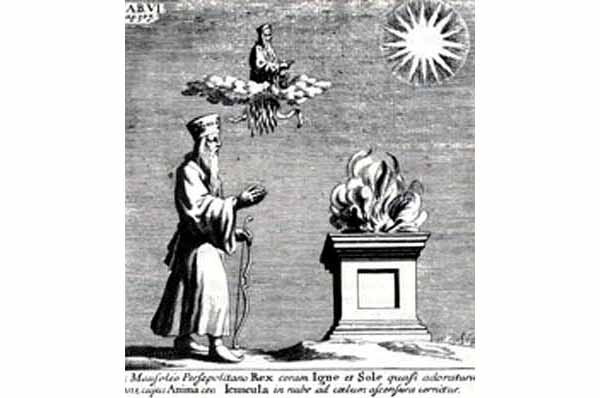
Does it not look similar to the Greek sun pictured further up in this post? Can Greeks and Macedonians now claim the Zoroastrian peoples in the region to be Alexander's descendants?
Or even the Kurds. Can the Kurds be claimed to be Alexander's descendants based on the common sun symbol between the Greeks/Macedonians and them?
The point I'm trying to make is that the culture and religion of the Kalash does not resemble pre-Christian Greek or Macedonian culture because the Kalash are an "off-shoot" of Alexander's army, but due to a common origin between the cultures of pre-Christian/Muslim/Buddhist etc. cultures and religions of IE peoples- including the pre-Islamic ancestors of most Pakistanis.
Linguistic evidence:
Greek and Macedonian are both IE languages. Greek is an isolated language in the IE family belonging to the Centum sect, while Macedonian is a Slavic language belonging to the Satem sect.
The language of the Kalash on the other hand belongs to the Dardic branch of IE. Linguists sometimes place Dardic as part of Indo-Aryan, but a distinct form of Indo-Aryan or "Northern Indo-Aryan."
To claim the Kalash as one of theirs, Greeks and Macedonians would have to explain how a Greek/Slavic speaking people, switched to Dardic. Some would possibly argue it is due to being surrounded by Dardic speaking populations.
Though I might be wrong, sources I've come across have indicated that language shift usually leaves traces of the previous language of an ethnic group in the new language that they have adopted.
Outside of a common Proto-Indo-European (PIE) source, can any traces of Slavic or Greek words be found in Kalashamondr? If so is it possible other Dardic languages such as Kashmiri or any other carry this?
Also on the subject of linguistics, why are the languages of the Chitral Valley (home of the Kalash) not written in Greek script or any script for that matter?
Their isolated position has protected their culture and spirituality, so surely their alleged "Greek" script could have been protected as well.
Even if not used in regular communication, why can't any Greek writing be found on their cultural items or tools used in regular life?
Genetic evidence:
According to sources, Haplogroup J2 is found primarily amongst Mediterranean populations, regardless of the linguistic diversity in that region.
Also according to this source, (don't know how reliable) certain subclades of Haplogroup J2 coincide with historic records of Greek colonization worldwide.
This makes sense. Since Pakistanis are predominantly members of Haplogroup R1, a subclade of Haplogroup R.
The only significant J2 markers found in Pakistan are in Pakhtunkhwa/NWFP, Punjab and parts of Sindh. This directly coincides with Greek colonization of Pakistan.
Even a Bangladeshi gentlemen who is an associate of mine is part Pakhtun. I've come across many Bangladeshis who are part Pakhtun including one person in my paternal family who has Pakhtun and Bengali roots from his mother's side.
That being mentioned, this associate of mine claims to have Greek ancestry from his Pakhtun side of the family- again coinciding with sources of Greek genetic influence in the Pakhtun population.
Had the Kalash or other Northern Pakistanis been of Greek descent, more significant markers of Haplogroup J2 would have been found in Northern Pakistan instead of being limited to mostly Pakhtunkhwa and Punjab.
Other evidence:
According to this site, Alexander the Great himself described light-skinned people in the Chitral Valley.
In the linked site, there is also a claim that Alexander encountered wooden boxes used by these peoples as coffins, which Alexander and his army used to burn wood.
This statement is also found in the book Empires of the Indus by Alice Albinia.
It states under a picture of these coffins that Alexander and his men found them and burned them for fire. This is possibly due to the fact that Northern Pakistan has cold climates even during the summer (I myself have been there in the summer and experienced the cold nights) because of the high altitude.
The Kalash are known to place their dead in wooden coffins which are then placed in the mountains.
This fact is also mentioned in Alice Albinia's book.
Alexander finding these wooden coffins and making a clear mention of white people in the Chitral Valley is more clear evidence of the Kalash and other Dardic peoples already being in this region much before his arrival. Historians and anthropologists estimate the first Aryan invasions in the subcontinent happened around 1700 to 1500 BC, well over a thousand years before Alexander's invasion which occurred in the third century BC.
Concealing their dead in wooden coffins might be a tradition the Kalash also inherited from Proto-Indo-European/"Kurgan culture" though I can't be certain until I further research this tradition.
Additional evidence going against the "Alexander's descendants" theory are the lack of Greek/Macedonian artifacts found in the culture of the Kalash. Take for example this coin pictured below followed by a head bust. Both were supposedly used during the Gandharran Civilization following Alexander's conquest:

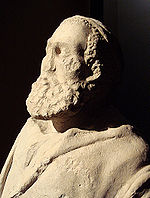
No known inscriptions of Greek heroes on their pottery or Greek gods in their places of worship.
Readers reading this post will have noticed that I have not made much mention of the Hunza.
The reason is because there is even little the Greeks or Macedonians can provide for their supposed "connection" to the Hunza especially on linguistic grounds.
The language of the Hunza, Burushaski is a language isolate and bears no known genetic relationship to any other language on Earth.
In fact most of Pakistan's languages which are Indo-European have much more in common with Greek and Macedonian than Burushaski does.
Even DNA tests carried out in 2008 show no link between the Hunza and the Macedonians. The origins of the Hunza are shrouded in mystery and no written records of their language exist. Some Tibetan sources mention this language, but written in local Tibetan languages.
The proposed Na-Dene Caucasian family had included the Burushaski language as one of it's members. But according to some websites, further research excludes this language from the proposed family.
Most Greek and Macedonian claims over these people would not be taken seriously, especially based on the facts I have posted above. And even if they were taken seriously, questions would then later arise on the validity of these claims.
Some last notes:
I would like to apologize to any Greeks and Macedonians reading this post. I understand that not all people from Greece and Macedonia claim Northern Pakistani populations as Alexander's descendants.
It's also a noticeable fact that many peoples in Pakistan and third world countries like to claim ancestries which has little or nothing to do with them.
Such as Pakistanis claiming Arab or Mughal ancestry with little evidence on the basis of feeling 'more Muslim.'
Other people do it sometimes because they are manipulated to do so such as some Kashmiris, Pakhtuns and Balochis claiming Jewish or other Semitic ancestries, which shall be discussed in another post.
There are even others sometimes paid to speak in favor of accepting a foreign nation's claim over their ethnicity.
Knowing the poverty in Pakistan, it should hardly be surprising that some individuals would accept bribes into accepting these claims.
The best way to counter such claims is with counter claims backed by evidence and facts. The truth and knowledge are the most powerful tools in winning arguments. Always.
Tuesday, April 20, 2010
Are Indians and Pakistanis the same people?
We often do hear Indians and Muhajirs chanting that Indians and Pakistanis are the same people and there's absolutely no difference between the two.
Some go as far to say that the people of the subcontinent are all "exactly the same" divided by political boundaries.
People who normally chant this draw out ignorant statements or try to convince everyone by chanting the same statement over and over again to the point that people stop questioning it.
I want to touch on the most common arguments that have been made in favor of this idea.
Appearance:
This argument is that Indians and Pakistanis are often mistaken for the same by outsiders and that's "proof" of their supposed "common origin." But then again Pakistanis are often lumped up with Arabs and other Middle Eastern peoples. When I moved to North America, people took me for an Arab. Does that make me an Arab? Does it mean Pakistanis have common origins with Arabs?
The same can be stated for Indians. What's more is only a small minority of people living in Northwestern India resemble Pakistanis when it comes to appearance. Other Indians sometimes look like exact opposites of Northern Pakistanis in terms of appearance. Northern Pakistanis are often tall, of fair complexion resembling Europeans while people from other parts of India often show East Asian or Australoid features with dark skin.
Also, there are "Indians" who are actually people who migrated from Pakistan during independence in 1947 and share common genetics, culture, linguistics with the rest of Pakistan, not with their adopted country.
Demographics:
Another common argument is that due to the shared provinces of Punjab and Kashmir, the two populations are "the same."
One problem is that Kashmir is not recognized as an "Indian state" by Pakistan or the United Nations. It is currently disputed territory and often seen as the fifth province of Pakistan. Only India sees Kashmir as an Indian state.
Neither do the people belong to the common North Indian haplogroup of R2 and it's possible subclades.
In fact Kashmiris are amongst the highest carriers of R1A in Asia, lumping them closer to Eastern European populations than Indian ones.
The other problem is that it is only Punjab that is split between India and Pakistan. The other provinces and populations are not shared by India and Pakistan. Even the populations in these unshared provinces between the two countries are completely distinct.
The major ethnic groups Balochis, Pakhtuns, Sindhis, Kashmiris and other populations of Pakistan are completely different from Indian populations and are not found in India except for some who migrated.
Pakistan also shares some of these mentioned ethnicities with Iran and Afghanistan, yet few have argued in favor of lumping Iran or Afghanistan with Pakistan.
Likewise the many dozens of ethnic groups from Tamils, Bengalis, Rajesthanis, Orissans, Telagu, Kannadas and many others are not found in Pakistan.
Even the various populations of India have little in common with one another.
India itself is so diverse that even the existence of a single "Indian" culture, language or people is not there. India can be compared to the former USSR, while Pakistan can be better compared to Yugoslavia or Switzerland, a home of various distinct, but related cultures and peoples.
Linguistics:
Some shared languages between the two countries especially Hindustani (mostly today called Hindi and Urdu) which is the lingua franca of the subcontinent is used as a basis to argue the "oneness" of Indians and Pakistanis.
Many countries share common languages for various reasons. The Hindustani language developed due to Mughal rulers of the subcontinent who were neither Indian nor Pakistani by origin.
Other shared languages such as Sindhi are due to migration between the two countries.
English is another language often used as a language of business in the two countries and also a legacy of British rule. Does this make the two peoples "one?"
Iran and Iraq have shared languages and demographics of Kurdish, Arab and Turkic populations. No one bothers to term them "one."
Most languages spoken in India are not spoken or understood in Pakistan and vice versa. Most of Pakistan's languages except for Brahui, Burusho and Baltistani are of Indo-European origins.
India's languages on the other hand are around seventy percent Indo-European and the other thirty percent being Dravidian, Sino-Tibetan, Austro-Asiatic and some other language isolates.
Genetics:
This is probably the strongest argument debunking Pan-South Asian propaganda. Most often, cheerleaders of Indo-Pakistani 'commonality' do not wish to back up their claims with evidence and will rely only on repeating their statements to win agreement.
If one is to search the distributions of haplogroups in the two countries, there is little in common. Even the common Indo-European haplogroup R found in Pakistanis and Northwestern Indians breaks into haplogroup R1A and R2 (sometimes also refereed to as R1B2).
This places Pakistani populations; especially Northern Pakistanis into closer genetic lineages with Eastern European populations than to Indian ones.
Also knowing the fair appearance of Northern Pakistanis and their Indo-European languages, this should hardly be surprising. But even still, it does not make them "the same" as East Europeans, because comparing the two in the 21st century based on ancient links is absurd.
So if they cannot be compared to those people, why would the diverse Indians, most of which are not related be compared to them?
It is also not just the differing distributions of haplogroup R but also various other haplogroups common to India but not to Pakistan. Most Indian haplogroups are not even found in Pakistan.
The haplogroup maps below give us a brief insight: (click to enlarge)
.jpg)
.jpg)

Though the videos below are not exactly accurate in genetics and wrongly calls Indo-Iranic "Indo-Iranian" as well as using the pseudo-anthropological word "desi" and also incorrectly referring to India as "Hindustan," they are still mostly factual and detailed otherwise:
Some go as far to say that the people of the subcontinent are all "exactly the same" divided by political boundaries.
People who normally chant this draw out ignorant statements or try to convince everyone by chanting the same statement over and over again to the point that people stop questioning it.
I want to touch on the most common arguments that have been made in favor of this idea.
Appearance:
This argument is that Indians and Pakistanis are often mistaken for the same by outsiders and that's "proof" of their supposed "common origin." But then again Pakistanis are often lumped up with Arabs and other Middle Eastern peoples. When I moved to North America, people took me for an Arab. Does that make me an Arab? Does it mean Pakistanis have common origins with Arabs?
The same can be stated for Indians. What's more is only a small minority of people living in Northwestern India resemble Pakistanis when it comes to appearance. Other Indians sometimes look like exact opposites of Northern Pakistanis in terms of appearance. Northern Pakistanis are often tall, of fair complexion resembling Europeans while people from other parts of India often show East Asian or Australoid features with dark skin.
Also, there are "Indians" who are actually people who migrated from Pakistan during independence in 1947 and share common genetics, culture, linguistics with the rest of Pakistan, not with their adopted country.
Demographics:
Another common argument is that due to the shared provinces of Punjab and Kashmir, the two populations are "the same."
One problem is that Kashmir is not recognized as an "Indian state" by Pakistan or the United Nations. It is currently disputed territory and often seen as the fifth province of Pakistan. Only India sees Kashmir as an Indian state.
Neither do the people belong to the common North Indian haplogroup of R2 and it's possible subclades.
In fact Kashmiris are amongst the highest carriers of R1A in Asia, lumping them closer to Eastern European populations than Indian ones.
The other problem is that it is only Punjab that is split between India and Pakistan. The other provinces and populations are not shared by India and Pakistan. Even the populations in these unshared provinces between the two countries are completely distinct.
The major ethnic groups Balochis, Pakhtuns, Sindhis, Kashmiris and other populations of Pakistan are completely different from Indian populations and are not found in India except for some who migrated.
Pakistan also shares some of these mentioned ethnicities with Iran and Afghanistan, yet few have argued in favor of lumping Iran or Afghanistan with Pakistan.
Likewise the many dozens of ethnic groups from Tamils, Bengalis, Rajesthanis, Orissans, Telagu, Kannadas and many others are not found in Pakistan.
Even the various populations of India have little in common with one another.
India itself is so diverse that even the existence of a single "Indian" culture, language or people is not there. India can be compared to the former USSR, while Pakistan can be better compared to Yugoslavia or Switzerland, a home of various distinct, but related cultures and peoples.
Linguistics:
Some shared languages between the two countries especially Hindustani (mostly today called Hindi and Urdu) which is the lingua franca of the subcontinent is used as a basis to argue the "oneness" of Indians and Pakistanis.
Many countries share common languages for various reasons. The Hindustani language developed due to Mughal rulers of the subcontinent who were neither Indian nor Pakistani by origin.
Other shared languages such as Sindhi are due to migration between the two countries.
English is another language often used as a language of business in the two countries and also a legacy of British rule. Does this make the two peoples "one?"
Iran and Iraq have shared languages and demographics of Kurdish, Arab and Turkic populations. No one bothers to term them "one."
Most languages spoken in India are not spoken or understood in Pakistan and vice versa. Most of Pakistan's languages except for Brahui, Burusho and Baltistani are of Indo-European origins.
India's languages on the other hand are around seventy percent Indo-European and the other thirty percent being Dravidian, Sino-Tibetan, Austro-Asiatic and some other language isolates.
Genetics:
This is probably the strongest argument debunking Pan-South Asian propaganda. Most often, cheerleaders of Indo-Pakistani 'commonality' do not wish to back up their claims with evidence and will rely only on repeating their statements to win agreement.
If one is to search the distributions of haplogroups in the two countries, there is little in common. Even the common Indo-European haplogroup R found in Pakistanis and Northwestern Indians breaks into haplogroup R1A and R2 (sometimes also refereed to as R1B2).
This places Pakistani populations; especially Northern Pakistanis into closer genetic lineages with Eastern European populations than to Indian ones.
Also knowing the fair appearance of Northern Pakistanis and their Indo-European languages, this should hardly be surprising. But even still, it does not make them "the same" as East Europeans, because comparing the two in the 21st century based on ancient links is absurd.
So if they cannot be compared to those people, why would the diverse Indians, most of which are not related be compared to them?
It is also not just the differing distributions of haplogroup R but also various other haplogroups common to India but not to Pakistan. Most Indian haplogroups are not even found in Pakistan.
The haplogroup maps below give us a brief insight: (click to enlarge)
.jpg)
.jpg)

Though the videos below are not exactly accurate in genetics and wrongly calls Indo-Iranic "Indo-Iranian" as well as using the pseudo-anthropological word "desi" and also incorrectly referring to India as "Hindustan," they are still mostly factual and detailed otherwise:
Monday, March 29, 2010
The "Muhajirs" in Pakistan and their diverse backgrounds.
Many in Pakistan think of Urdu-speaking people originally from the state of Utter Pradesh in present-day North India when they think of Muhajirs.
Actually what most people might not know is that the state of Utter Pradesh was manufactured by the British in the 1930s.
What most people also do not know is that most "Muhajirs" are not a common ethnicity but various peoples from different parts of the subcontinent. The only common trait they have is the common Hindustani language which is no the Lingua Franca of the subcontinent.
This does not mean their natives languages were Lashkari ('Urdu') or whatever you may call it.
I have met "Muhajirs" who trace their roots back to Bengal, South India and other part of the subcontinent. Most of them don't even know a word of Bengali or other languages of their parents.
I even met a person at a hospital who claimed he had a Tamil Muslim friend who's family migrated to Pakistan.
Even in her book Empires of the Indus, the British author Alice Albina writes that during independence, some forty four thousand immigrants from all over India migrated to Pakistan.
This information can be found in her book on page sixteen paragraph two. "Some forty four thousand Muslims government employees- tea boys and peons, civil servants and politicians; and their spouses, parents and children- took the train from all over India and came to Pakistan. Naturally, they hollered for housing, they camped in Karachi's school, they filled up its lovely green spaces with their clamorous existence."
Imagine these immigrants and their descendants now. Their numbers must have increased dramatically to millions knowing Karachi's massive population. To know the history of the "Muhajirs" and their presence in Pakistan, each ethnicity of a Muhajir family and their background must be investigated.
For decades "Muhajirs" have been lumped as a whole on the basis of a common first language they speak today. The purpose of this post is to show that is clearly not the case and that "Muhajirs" are from various backgrounds, both Indian and Non-Indian alike.
Actually what most people might not know is that the state of Utter Pradesh was manufactured by the British in the 1930s.
What most people also do not know is that most "Muhajirs" are not a common ethnicity but various peoples from different parts of the subcontinent. The only common trait they have is the common Hindustani language which is no the Lingua Franca of the subcontinent.
This does not mean their natives languages were Lashkari ('Urdu') or whatever you may call it.
I have met "Muhajirs" who trace their roots back to Bengal, South India and other part of the subcontinent. Most of them don't even know a word of Bengali or other languages of their parents.
I even met a person at a hospital who claimed he had a Tamil Muslim friend who's family migrated to Pakistan.
Even in her book Empires of the Indus, the British author Alice Albina writes that during independence, some forty four thousand immigrants from all over India migrated to Pakistan.
This information can be found in her book on page sixteen paragraph two. "Some forty four thousand Muslims government employees- tea boys and peons, civil servants and politicians; and their spouses, parents and children- took the train from all over India and came to Pakistan. Naturally, they hollered for housing, they camped in Karachi's school, they filled up its lovely green spaces with their clamorous existence."
Imagine these immigrants and their descendants now. Their numbers must have increased dramatically to millions knowing Karachi's massive population. To know the history of the "Muhajirs" and their presence in Pakistan, each ethnicity of a Muhajir family and their background must be investigated.
For decades "Muhajirs" have been lumped as a whole on the basis of a common first language they speak today. The purpose of this post is to show that is clearly not the case and that "Muhajirs" are from various backgrounds, both Indian and Non-Indian alike.
Wednesday, March 24, 2010
Where and what is Hindustan?
Many modern-day people seem to think of Hindustan as a synonym for the country India. This is an incorrect understanding of the word and the history behind it. Even the understanding of Hindustan as "land of Hindus" is a misconception.
Other people think of this as a regional term for the whole subcontinent. According to geographers and historians, the region of Hindustan covers the Ganges valley in Northern India and the Punjab and Sindh regions of Eastern Pakistan. It also includes Rajesthan and the Delhi region and perhaps parts of China which touches points of the Indus river.
It does not refer to the entire subcontinent, let alone all of India.
According to my knowledge, the word was used by the Mughals for the territories they controlled in South Asia, which was mostly North India, North Eastern Pakistan and Bangladesh.
The word Hindustan most likely has it's roots in Hind, which in term is a corruption of the word Sindh, from the Sanskrit Sindhu which came from "Sapta Sindhu" meaning "land of the rivers."
Sapta Sindhu or the land of the rivers included the river-covered areas of eastern Pakistan and northwestern India.
The Persians who frequently visited the subcontinent through out the centuries, referred to the region as "Hind." This word was most likely a synonym for Sindhu.
For those who do not know, the Mughals were a mostly Persian-led empire with an army of Turko-Mongols. But this army was one of many Persian armies that visited South Asia going back centuries before the common era.
If Hind had the same meaning behind Sindh, then being a Persian led force, the Mughals continued to use the word Hind to refer to the region of rivers in South Asia as their ancestors did, which was mostly the Ganges Valley in Northern India and the Indus Valley in central and eastern Pakistan.
If these theories are correct, it coincides with the original marking of Hindustan which cuts through North India and North Eastern Pakistan. The Mughal word Hindustan could very well be a continuation of the word Hind.
Below is the map of the territories controlled by the Mughal Empire:

Another misconception is that Hindustan had a religious meaning. This is not true at all. As already known to many, the reference to "Hindu" and "Hinduism" as a collective religion did not exist until the arrival of the British who termed all the indigenous religions of South Asia as "one."
If Hind had the same meaning as "Sindh" then Hindustan would also mean "land of the rivers" which makes sense, since the area of Punjab and the Ganges valley was rules by the Mughals.
Sindh was not under Mughal rule as far as any sources state , nor do any maps show most of Pakistan being under Mughal rule.
Conclusively, the correct meaning of Hindustan is the region that cuts through Northern India and North Eastern Pakistan. It does NOT refer to India as a whole or even the subcontinent.
Nor does it refer to all of Pakistan.
Hindustan is historically a geographic term despite the fact that is has been politicized now. Even Hind and "Hindu" had no religious meaning until the British labeled the various pagan cults of South Asia as such into one "Hinduism."
A basic map of Hindustan which includes areas of Southern China:

Other people think of this as a regional term for the whole subcontinent. According to geographers and historians, the region of Hindustan covers the Ganges valley in Northern India and the Punjab and Sindh regions of Eastern Pakistan. It also includes Rajesthan and the Delhi region and perhaps parts of China which touches points of the Indus river.
It does not refer to the entire subcontinent, let alone all of India.
According to my knowledge, the word was used by the Mughals for the territories they controlled in South Asia, which was mostly North India, North Eastern Pakistan and Bangladesh.
The word Hindustan most likely has it's roots in Hind, which in term is a corruption of the word Sindh, from the Sanskrit Sindhu which came from "Sapta Sindhu" meaning "land of the rivers."
Sapta Sindhu or the land of the rivers included the river-covered areas of eastern Pakistan and northwestern India.
The Persians who frequently visited the subcontinent through out the centuries, referred to the region as "Hind." This word was most likely a synonym for Sindhu.
For those who do not know, the Mughals were a mostly Persian-led empire with an army of Turko-Mongols. But this army was one of many Persian armies that visited South Asia going back centuries before the common era.
If Hind had the same meaning behind Sindh, then being a Persian led force, the Mughals continued to use the word Hind to refer to the region of rivers in South Asia as their ancestors did, which was mostly the Ganges Valley in Northern India and the Indus Valley in central and eastern Pakistan.
If these theories are correct, it coincides with the original marking of Hindustan which cuts through North India and North Eastern Pakistan. The Mughal word Hindustan could very well be a continuation of the word Hind.
Below is the map of the territories controlled by the Mughal Empire:

Another misconception is that Hindustan had a religious meaning. This is not true at all. As already known to many, the reference to "Hindu" and "Hinduism" as a collective religion did not exist until the arrival of the British who termed all the indigenous religions of South Asia as "one."
If Hind had the same meaning as "Sindh" then Hindustan would also mean "land of the rivers" which makes sense, since the area of Punjab and the Ganges valley was rules by the Mughals.
Sindh was not under Mughal rule as far as any sources state , nor do any maps show most of Pakistan being under Mughal rule.
Conclusively, the correct meaning of Hindustan is the region that cuts through Northern India and North Eastern Pakistan. It does NOT refer to India as a whole or even the subcontinent.
Nor does it refer to all of Pakistan.
Hindustan is historically a geographic term despite the fact that is has been politicized now. Even Hind and "Hindu" had no religious meaning until the British labeled the various pagan cults of South Asia as such into one "Hinduism."
A basic map of Hindustan which includes areas of Southern China:

Monday, March 22, 2010
The Aryans of Pakistan
Many Pakistani history writers when discussing the pre-history of Pakistan, mention the Aryans as just one of the invaders alongside the Persians, the Greeks or the Mongols etc.
What they don't realize is that the situation of the Aryans was very different than that of the Persians, Arabs or others, for the Aryans are the ancestors of most modern-day Pakistanis, most likely alongside the native peoples of the Indus Valley.
As mentioned in another post of mine, Aryan does not necessarily mean a white-skinned person, but rather a person of wise or noble descent.
The word has it's roots in the Sanskrit word Aryaa meaning wise or noble.
Though I'm not entirely sure, I was reading on a forum that the literal meaning of Aarya was one who is ahead; hence more advanced.
This theory makes sense to me, as I've found words in Indo-European languages which contain the sound "A" at the beginning of words which indicate a forward direction.
For example the Urdu word for front "aagay" or words in English such as 'ahead' "again" (again indicating repeated cycles).
Even the word heir (pronounced Aa-yer) meaning a successor might be connected to "Aryan" or "Aarya," maybe having it's roots in an expression of after or beyond.
Though it's not a proven fact, it's a strong theory. Already the connection between most Pakistani and European languages is proven, thus pointing to the fact that most Pakistanis and Europeans do have common ancestry at least on Y-Chromosome lines:
We are the Aryans of Pakistan.
Most particularly this refers to those of Sindhi and Punjabi descent. The Aryans were the Sanskrit speakers who migrated from the Eurasian steppes along the Black Sea and later merged with the indigenous people of the Indus Valley. From their Sanskrit language came the modern languages of Punjabi, Sindhi, Urdu and other Indo-Aryan languages. About five centuries later they were followed by their distant relatives, the Iranic peoples.
Their descents are mainly the Pakhtuns and the Baloch. All languages derived from Vedic Sanskrit are Indo-Aryan languages and those who descend from the Vedic Aryans are the modern Indo-Aryans.
The descendants of the early Iranic peoples who came to Pakistan are mainly the Pakhtuns and the Baloch and their languages belong to the Iranic sect of Indo-Iranic.
Click on the linguistic chart below to enlarge:

The Dardic people of Northern Pakistan are also derived from Proto-Indo-Aryans however their isolated position in the mountains has allowed them to evolve differently from Punjabis, Sindhis and other Indo-Aryan populations in Pakistan.
Genetically, the people of the Kashmir Valley and Northern Areas are closer to Eastern Europeans given they stayed in isolation and did not mix as much with indigenous races. Such isolation also allowed their languages to evolve more distinct from other Indo-Aryan languages as well as each others languages which is why they are often given the separate classification of "Dardic."
This name was given to the land by the ancient Greek explorer Herodotus.
The isolation of the Indo-Aryans today known as the Dards has also allowed them to preserve many aspects of their culture, particularly the non-Muslim Kalash population who practice a continuation of the prehistoric Indo-European religion(s).
The Aryans who started arriving around the seventeenth century BC were the most significant invaders, being our ancestors and bringing with them the Sanskrit language which became most of Pakistan's main languages.

The other invaders were not as significant since they did not leave many descendants. If one is to search haplogroup maps on Pakistan, there is not much Semitic, Mediterranean or Turanian markers in the Pakistani population.
Pakistanis are the decedents of the Aryan invaders combined with the native population of the Indus Valley; though it is not clear who the Indus Valley people(s) were.
There might have been other populations passing through, the IVC could have been a multi-ethnic society, but there are too many unsolved mysteries about what Pakistan was like before the Aryan invasion of the region.
What they don't realize is that the situation of the Aryans was very different than that of the Persians, Arabs or others, for the Aryans are the ancestors of most modern-day Pakistanis, most likely alongside the native peoples of the Indus Valley.
As mentioned in another post of mine, Aryan does not necessarily mean a white-skinned person, but rather a person of wise or noble descent.
The word has it's roots in the Sanskrit word Aryaa meaning wise or noble.
Though I'm not entirely sure, I was reading on a forum that the literal meaning of Aarya was one who is ahead; hence more advanced.
This theory makes sense to me, as I've found words in Indo-European languages which contain the sound "A" at the beginning of words which indicate a forward direction.
For example the Urdu word for front "aagay" or words in English such as 'ahead' "again" (again indicating repeated cycles).
Even the word heir (pronounced Aa-yer) meaning a successor might be connected to "Aryan" or "Aarya," maybe having it's roots in an expression of after or beyond.
Though it's not a proven fact, it's a strong theory. Already the connection between most Pakistani and European languages is proven, thus pointing to the fact that most Pakistanis and Europeans do have common ancestry at least on Y-Chromosome lines:
We are the Aryans of Pakistan.
Most particularly this refers to those of Sindhi and Punjabi descent. The Aryans were the Sanskrit speakers who migrated from the Eurasian steppes along the Black Sea and later merged with the indigenous people of the Indus Valley. From their Sanskrit language came the modern languages of Punjabi, Sindhi, Urdu and other Indo-Aryan languages. About five centuries later they were followed by their distant relatives, the Iranic peoples.
Their descents are mainly the Pakhtuns and the Baloch. All languages derived from Vedic Sanskrit are Indo-Aryan languages and those who descend from the Vedic Aryans are the modern Indo-Aryans.
The descendants of the early Iranic peoples who came to Pakistan are mainly the Pakhtuns and the Baloch and their languages belong to the Iranic sect of Indo-Iranic.
Click on the linguistic chart below to enlarge:

The Dardic people of Northern Pakistan are also derived from Proto-Indo-Aryans however their isolated position in the mountains has allowed them to evolve differently from Punjabis, Sindhis and other Indo-Aryan populations in Pakistan.
Genetically, the people of the Kashmir Valley and Northern Areas are closer to Eastern Europeans given they stayed in isolation and did not mix as much with indigenous races. Such isolation also allowed their languages to evolve more distinct from other Indo-Aryan languages as well as each others languages which is why they are often given the separate classification of "Dardic."
This name was given to the land by the ancient Greek explorer Herodotus.
The isolation of the Indo-Aryans today known as the Dards has also allowed them to preserve many aspects of their culture, particularly the non-Muslim Kalash population who practice a continuation of the prehistoric Indo-European religion(s).
The Aryans who started arriving around the seventeenth century BC were the most significant invaders, being our ancestors and bringing with them the Sanskrit language which became most of Pakistan's main languages.

The other invaders were not as significant since they did not leave many descendants. If one is to search haplogroup maps on Pakistan, there is not much Semitic, Mediterranean or Turanian markers in the Pakistani population.
Pakistanis are the decedents of the Aryan invaders combined with the native population of the Indus Valley; though it is not clear who the Indus Valley people(s) were.
There might have been other populations passing through, the IVC could have been a multi-ethnic society, but there are too many unsolved mysteries about what Pakistan was like before the Aryan invasion of the region.
Monday, March 1, 2010
Background of Hindi and Urdu (aka Hindui and Lashkari)
The average Hindutva will claim that Hindi is the continuation of the original Hindustani language while Undri or Urdu is a plagiarized form of Hindi, using Perseo-Arabic script and Persian, Arabic plus Turkic vocabulary. Many brainwashed Pakistanis buy into this idea.
Many would think that Hindi having more Sanskrit vocabulary would be closer to the original parent of these two languages, Sanskrit.
Actually, the reality of the matter is far from these beliefs. The original Hindustani language developed as a result of the Mughals trying to learn Sanskrit.
In doing so, many Persian and Turkic words entered the language since the Mughals were a Persian led empire with an army of Turko-Mongols.
It was later on that the Hindustani language was popularly nicknamed "Zaban-i-Ordu" or the language of the royal military camp since the Mughals were the military rulers and spoke Hindustani.
Later on, the nickname "Zaban-i-Ordu" was frequently called "Ordu" (Ordu means army in Turkic languages) for short. This name evolved into the local pronunciation "Urdu."
The reason for "Hindi" (another variant of Hindustani) not having Turkic, Arabic and Persian vocabulary and having more Sanskrit words is because deliberate efforts were made by Hindutva nationalists to remove vocabulary imported by the Muslim invaders.
The Sanskritization of Hindi started in the pre-independence era and continued on after independence of British rule. Not because Hindi is the 'original' variant of Hindustani.
The deliberate Sanskritization of is well documented in news articles, books and other academic publications.
So if the Turkic, Arabic, Persian vocab in Hindi has been removed as a deliberate act and not a result of natural linguistic evolution, can Hindutvas claim the modern Hindi language to be 'closer' to the original Hindustani language or even to Sanskrit?
Since modern Urdu or Undri retains most of the Turkic, Arabic and Persian vocabulary of Hindustani, it has a much higher ground over Hindustani than Hindi does.
An important fact to note is that the percentage of vocabulary from a parent language in the off-spring language is irrelevant in modern linguistics.
Urdu is said to have only about seven percent of it's vocabulary inherited from Sanskrit.
Modern Turkish has more than half of it's vocabulary inherited from Arabic and Persian, and to a lesser extent, Greek.
Despite all this, Turkish is still an Altaic language due to it's distinct structure unrelated to Arabic and Persian/Farsi.
Likewise, Urdu or Undri is an Indo-Aryan language because it's structural base originates from Sanskrit, regardless of it's vocabulary.
The Sanskritization of Hindi has been pushed to such an extreme that many Hindi-speaking Indians don't understand it anymore. That's how different it has become from the original Hindustani language.
This is probably the reason why Urdu/Undri has been selected for use in bollywood, to gain a larger audience, since many Hindi-speaking Indians cannot understand this heavily Sanskritized version of Hindi.
This usage of Urdu/Undri in bollywood has caused an outcry amongst Hindutvas, so the name Hindustani has been adopted to make it sound more neutral.
Another fact to note is that Hindustan and Hindustani do not have any religious meaning. The word "Hindu" used by most Indians today to refer to their 'religion' stems from the word "Hind" used by the Persians and later by the Arabs as well. This word evolves from the Sanskrit words "Sindh" and "Sindhu" meaning "land of the rivers" referring to the Indus Valley region and perhaps the Ganges plain.
It was from this word that the British coined 'Hinduism' to refer to the various pagan cults and religions in the subcontinent mostly unrelated to each other.
The Mughal usage of the words 'Hindustan' and 'Hindustani' has absolutely no religious basis, but geographical ones.
All these facts can easily be researched and based on them, it's fair to state that Urdu/Undri is not derived from modern Hindi, but instead Hindustani which in turn is derived from Sanskrit.
Though Urdu/Undri has evolved through centuries under different names from Hindwi to Hindustani to Urdu and Undri, it is an independent language of Hindi and always has been.
Many would think that Hindi having more Sanskrit vocabulary would be closer to the original parent of these two languages, Sanskrit.
Actually, the reality of the matter is far from these beliefs. The original Hindustani language developed as a result of the Mughals trying to learn Sanskrit.
In doing so, many Persian and Turkic words entered the language since the Mughals were a Persian led empire with an army of Turko-Mongols.
It was later on that the Hindustani language was popularly nicknamed "Zaban-i-Ordu" or the language of the royal military camp since the Mughals were the military rulers and spoke Hindustani.
Later on, the nickname "Zaban-i-Ordu" was frequently called "Ordu" (Ordu means army in Turkic languages) for short. This name evolved into the local pronunciation "Urdu."
The reason for "Hindi" (another variant of Hindustani) not having Turkic, Arabic and Persian vocabulary and having more Sanskrit words is because deliberate efforts were made by Hindutva nationalists to remove vocabulary imported by the Muslim invaders.
The Sanskritization of Hindi started in the pre-independence era and continued on after independence of British rule. Not because Hindi is the 'original' variant of Hindustani.
The deliberate Sanskritization of is well documented in news articles, books and other academic publications.
So if the Turkic, Arabic, Persian vocab in Hindi has been removed as a deliberate act and not a result of natural linguistic evolution, can Hindutvas claim the modern Hindi language to be 'closer' to the original Hindustani language or even to Sanskrit?
Since modern Urdu or Undri retains most of the Turkic, Arabic and Persian vocabulary of Hindustani, it has a much higher ground over Hindustani than Hindi does.
An important fact to note is that the percentage of vocabulary from a parent language in the off-spring language is irrelevant in modern linguistics.
Urdu is said to have only about seven percent of it's vocabulary inherited from Sanskrit.
Modern Turkish has more than half of it's vocabulary inherited from Arabic and Persian, and to a lesser extent, Greek.
Despite all this, Turkish is still an Altaic language due to it's distinct structure unrelated to Arabic and Persian/Farsi.
Likewise, Urdu or Undri is an Indo-Aryan language because it's structural base originates from Sanskrit, regardless of it's vocabulary.
The Sanskritization of Hindi has been pushed to such an extreme that many Hindi-speaking Indians don't understand it anymore. That's how different it has become from the original Hindustani language.
This is probably the reason why Urdu/Undri has been selected for use in bollywood, to gain a larger audience, since many Hindi-speaking Indians cannot understand this heavily Sanskritized version of Hindi.
This usage of Urdu/Undri in bollywood has caused an outcry amongst Hindutvas, so the name Hindustani has been adopted to make it sound more neutral.
Another fact to note is that Hindustan and Hindustani do not have any religious meaning. The word "Hindu" used by most Indians today to refer to their 'religion' stems from the word "Hind" used by the Persians and later by the Arabs as well. This word evolves from the Sanskrit words "Sindh" and "Sindhu" meaning "land of the rivers" referring to the Indus Valley region and perhaps the Ganges plain.
It was from this word that the British coined 'Hinduism' to refer to the various pagan cults and religions in the subcontinent mostly unrelated to each other.
The Mughal usage of the words 'Hindustan' and 'Hindustani' has absolutely no religious basis, but geographical ones.
All these facts can easily be researched and based on them, it's fair to state that Urdu/Undri is not derived from modern Hindi, but instead Hindustani which in turn is derived from Sanskrit.
Though Urdu/Undri has evolved through centuries under different names from Hindwi to Hindustani to Urdu and Undri, it is an independent language of Hindi and always has been.
Sunday, February 21, 2010
Tuesday, February 9, 2010
Religions in Pakistan in the pre and post Islamic era.
Contrary to popular belief, "Hinduism" is not a religion, but many distinct religions stereotyped as a "single religion" by the British.
It's very much like calling the various cults/religions of South America (Aztec, Mayan, Inca) "South Americanism."
Just about every region in the world had various cults/religions. The Middle East was filled with various religions (and still is, though not as much as before) such as Yazidism, Zoroastrianism, Arab paganism, Druze just to name a few.
Likewise, Pakistan and it's surrounding regions were diverse in religions and spirituality.

A Shaman from the Hunza Valley in Northern Pakistan.
Traces of Zoroastrianism, Shamanism, Buddhism, Sufism (now combined with Islam), Indo-Iranic paganism (now survived by the Kalash) can be found.
Even today minorities and Muslims can be found practicing all the mentioned religions/cults and most recently Sikhism, which formed much after the others.

Sikh children in Pakistan.
What is known to few is that the people of Sindh were predominantly Buddhist prior to the Arab conquest led by Muhammad Bin Qasim. There were Brahmins too, whom today identify themselves as "Hindus."
Also contrary to popular belief, Islam was not spread and well established under Arab rule.
The Arab rulers managed to establish a temporary presence in coastal areas of Pakistan and other coastal parts of the subcontinent including nearly all of Sindh.
Some coastal areas of India may also have been exposed to Islam since Arab traders have been sailing to the Indian peninsula for centuries due to trade and commerce.
But the real establishment of Islam occurred with the conquest of Turkic empires starting with the Ghaznavids as they are the first recorded Islamic empire to invade from Central Asia. It all ended with the Mughals who were the last Muslim empire in South Asia.

A Buddhist artifact from Gandhara. Buddhism gained strength in Pakistan during Mauryan rule and during the Greco-Bactrian establishment.
But never in the history of Pakistan or humanity was there ever a religion called "Hinduism."
No ancient text weather Sanskrit, ancient Persian, ancient Greek or other mentions such a religion.
The Arabs noted at least 42 distinct cults/religions in their writings from sun worshipers to snake and idol worshipers.
A brief insight into the history and origins of so-called "Hinduism" can be found here.
The religion of the Indus Valley Civilization is yet to be known considering weather they even had a single religion or any religion at all.
Traces of Greek paganism can also be found due to Greek rule of Pakistan starting around the third century BC. Monuments and artifacts of their mythology can be found in North Western Pakistan especially Gandhara and Taxila.
However, no followers of Greek paganism can be found in Pakistan today.
A Greek bust from the Greek Kingdom in Northern Pakistan.
It's very much like calling the various cults/religions of South America (Aztec, Mayan, Inca) "South Americanism."
Just about every region in the world had various cults/religions. The Middle East was filled with various religions (and still is, though not as much as before) such as Yazidism, Zoroastrianism, Arab paganism, Druze just to name a few.
Likewise, Pakistan and it's surrounding regions were diverse in religions and spirituality.
A Shaman from the Hunza Valley in Northern Pakistan.
Traces of Zoroastrianism, Shamanism, Buddhism, Sufism (now combined with Islam), Indo-Iranic paganism (now survived by the Kalash) can be found.
Even today minorities and Muslims can be found practicing all the mentioned religions/cults and most recently Sikhism, which formed much after the others.
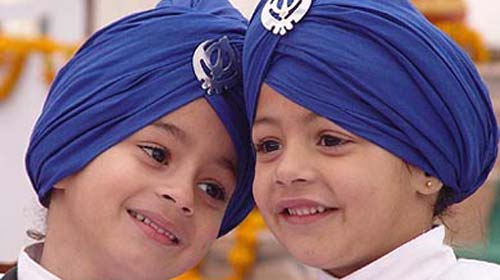
Sikh children in Pakistan.
What is known to few is that the people of Sindh were predominantly Buddhist prior to the Arab conquest led by Muhammad Bin Qasim. There were Brahmins too, whom today identify themselves as "Hindus."
Also contrary to popular belief, Islam was not spread and well established under Arab rule.
The Arab rulers managed to establish a temporary presence in coastal areas of Pakistan and other coastal parts of the subcontinent including nearly all of Sindh.
Some coastal areas of India may also have been exposed to Islam since Arab traders have been sailing to the Indian peninsula for centuries due to trade and commerce.
But the real establishment of Islam occurred with the conquest of Turkic empires starting with the Ghaznavids as they are the first recorded Islamic empire to invade from Central Asia. It all ended with the Mughals who were the last Muslim empire in South Asia.

A Buddhist artifact from Gandhara. Buddhism gained strength in Pakistan during Mauryan rule and during the Greco-Bactrian establishment.
But never in the history of Pakistan or humanity was there ever a religion called "Hinduism."
No ancient text weather Sanskrit, ancient Persian, ancient Greek or other mentions such a religion.
The Arabs noted at least 42 distinct cults/religions in their writings from sun worshipers to snake and idol worshipers.
A brief insight into the history and origins of so-called "Hinduism" can be found here.
The religion of the Indus Valley Civilization is yet to be known considering weather they even had a single religion or any religion at all.
Traces of Greek paganism can also be found due to Greek rule of Pakistan starting around the third century BC. Monuments and artifacts of their mythology can be found in North Western Pakistan especially Gandhara and Taxila.
However, no followers of Greek paganism can be found in Pakistan today.
Friday, January 29, 2010
Thursday, January 14, 2010
The different peoples of the Indus Valley and their possible origins


Let's begin with the first question of who were the people of the Indus Valley Civilization? What cults/religion(s) did they follow? What language(s) did they speak?
These questions even today still remain unanswerable.
However from what is so far known, they were not Indo-European, neither was their language(s).
Many Indian sources claim them to be be Dravidians or Elamites, the supposed close relatives of the Dravidians. The theory goes further to state that they were pushed south and scattered by Aryan invasions, which resulted in them being found in south India mostly and the Brahuis who are an isolated group of Dravidians.
This theory has been rejected by many Pakistani historians and archeologists. Some have claimed that the Brahuis are descendants of recent Dravidian nomads who came and settled in present-day Balochistan.
Other sources point more westward towards Iran, where the ancient Elamites lived.
Many have also rejected the presence of Dravidians in the Pakistan region and that the decedents of the Indus Valley are present-day Pakistanis.
Though I am no qualified expert, my research and understanding has led me to believe that the Indus Valley region/Pakistan has been a home to Dravidians or at least had a strong influence of Dravidian language/culture possibly going as far back as the time of the Aryan invasion(s).
Though lack of genetic evidence exists and the Haplogroup L maps show lack of Dravidian markers present in Pakistan (haplogroup L has been associated with Dravidians as opposed to the Haplogroup R found mostly in Indo-European speaking peoples), linguistic evidence still remains.
The presence of heavy Dravidian-sounding consonants in Indo-Aryan languages of Pakistan especially Sindhi, points only to a likely Dravidian origin. In fact, many in Pakistan mistake Sindhi for a Dravidian language because of it's sound.
Not only, Sindhi and Punjabi, but almost every Indo-Aryan language that I have heard being spoken (including my native Urdu/Undri) carry to a certain degree what appears to be Dravidian lexical influences.
Certain Pakistani linguists and historians had even hypothesized that the people of Pakistan could be Dravidians who adapted to Indo-European languages from the invaders.
Dravidian consonants in the Indo-Aryan languages of Pakistan represented in Perseo-Arabic script:
ٹ Letter name tay. Pronounced t'd
ڈ Letter name daal. Pronounced d'd
ڑ Letter name ray. Pronounced r'd
All the consonants listed are used in Dravidian languages.
Sindhi, Rajesthani, Punjabi, Bengali seem to use them a lot. They are hardly heard in Urdu in comparison, but still used occasionally.
In fact, no other branches in Indo-European that I know of use these consonants (and perhaps vowels).
Based on the location of Pakistan's Indo-Aryan languages about a thousand miles from South India, can the presence of these consonants be coincidental then?
This question only strengthens the theory of Dravidian presence in other parts of the subcontinent till a certain point.
Because no physical linkages have been found between Dravidians and the people of the Indus Valley (including anthropological findings by Proffessor Ahmed Hassan Dani), I have disagreed with the theory of the Indus Valley Civilization being Dravidian, but not ruled it out completely yet.
My personal theory is that the Indus Valley people were washed away by natural disasters. Evidence of this was found in Mohenjo-daro which was contained houses and people covered in mud.
Those who survived, were assimilated or destroyed by the Aryan invaders, since sources do state that evidence exists of battles between the IVC people and the Aryan invaders. Apparently pieces of weaponry and fossils are parts of this evidence.
With the IVC people gone, the Dravidians came and settled into the possibly uninhabited lands. When exactly or even approximately they came is hard to say.
Perhaps the land was already inhabited by a new race of IVC people and Aryans mixed together.
But with many historians also theorizing the Dravidians coming from more northward and small pockets still found in Afghanistan, Pakistan and Iran, the evidence of their presence in other parts of the region, outside of South India remains undeniable.
There has also been linguistic evidence pointing the Dravidians all the way far north of Asia towards regions around the Ural and Altay mountain regions.
Based on similar linguistic findings between Altaic and Dravidian, hypothetical links have been proposed. (People should remember these links are not proven in anyway and are only proposed based on evidence found so far).
A similar finding pointed a possible relationship to Finno-Ugric languages, a subfamily of the Uralic family. These are based on similar vocabulary and common grammar.
Grammatically speaking Uralic, Altaic and Dravidian languages are all considered agglutinative languages.
However, these theories suggesting a common origin or even a connection for the three mentioned language families still remain unproven.
Coming back to the possibility of Dravidian presence in Pakistan; the linguistic evidence remains.
Again the Dravidian consonants in the Indo-Aryan languages of Pakistan represented in Perseo-Arabic script:
ٹ Letter name t'day. Pronounced t'd
ڈ Letter name d'taal. Pronounced d'd
ڑ Letter name r'day. Pronounced r'd
There are also perhaps vowels in Indo-Aryan languages pronounced similarly to Dravidian languages as opposed to their first cousins the Iranic languages.
The absence of certain vowel pronunciations common to Iranic languages are absent in Indo-Aryan languages similarly in the case of Dravidian.
For example, the lack of near-open front unrounded vowel (A in English) /æ/ as in 'sack' is noticeably mostly absent in Indo-Aryan languages, as opposed to their Iranic cousins.
Noticeable Iranic languages like Pashto or Farsi can be found containing it and similar vowels and pronunciations absent in most Indo-Aryan languages.
As an example the Farsi word b-æ-t shoh for King whereas Urdu would be b-aa-t Sh-aah.
Or a clear Pashto pronunciation of the Urdu/Undri word for Sahab (Sa-h-aab) meaning Sir would be Sa-æ-h-æ-b.
Similarly, with the case of the pronunciation of O. In major Iranic languages like Farsi (Central Iranic) or Pashto (Eastern Iranic), O can be pronounced as an open back rounded vowel ('short O' in English). Or even the Shoh in B-æ-t Shoh.
This is not present in all the Indo-Aryan languages I've come across such as Sindhi, Punjabi or my native Urdu.
As an example 'Nadir' can be pronounced in Farsi and Pashto as N-o-dir, whereas in Urdu/Undri the pronunciation is flat Naa-dir.
Note: Iranic languages in Pakistan might use r'd d'd or t'd due to word borrowing from Indo-Aryan languages or even from Brahui.
While Iranic languages can use flat vowel pronunciations, Indo-Aryan languages cannot near-open front unrounded vowel pronunciation or so it seems.
These videos of Pakistani patriotic songs show the difference of vowel usage in Pashto (Iranic) and Urdu/Undri (Indo-Aryan). Even if you speak only one or neither of these languages, you will still be able to see the difference in vowel usage.
In the first video of a song in Pashto you can hear the pronunciation of word for world as "doonya" using oʊ close mid-rounded vowel:
In the case of Urdu it is rather different with the word for world in this video pronounced "dunya." Notice how the pronunciation is rather flat compared to the Pashto song:
Though the Pashto and other Iranic languages spoken in Pakistan have ٹ in their alphabetical system, I believe it was borrowed because other Iranic languages such as Farsi do not seem to contain it or similar sounds, plus ڈ or ڑ etc. are rarely used in Pashto.
This brings an interesting question that could argue against Dravidian impact on Indo-Aryan peoples and languages and the similarities being purely coincidental. Why do Indo-Aryan languages have similar pronunciations to Dravidian languages (some far less, while others much more), yet are related grammatically/genetically to their Iranic cousins which have none or no significant use of these consonants and vowels?
After thinking of this question, I had theorized for a while that the 'Aryan' invasion occurred in at least two separate waves. The ancestors of the Indo-Aryan speaking peoples of Pakistan and other parts of South Asia arrived first sometime between the 12th and 20th century BC.
They brought what became the Sanskrit language and then later on the modern Indo-Aryan languages. They settled around what at that time was a Dravidian majority area and co-existed with the Dravidians, exchanging aspects of language and culture with them and it is likely race mixing also took place. (though haplogroup maps do not show a high occurrence of Indo-European peoples breeding with the Dravids).
There are also plenty of words found to be shared between Sanskrit and Dravidian languages.
It was later on in a second wave(s) that the ancestors of Iranic speaking Pakistanis and others in the region came and settled in present-day Pakistan, Iran and Afghanistan.
By this time most of the Dravidian populations had moved further south with the exception of a few. This could be due to the possible pressure from the growth of the Indo-Iranic speaking populations or even enforced by the Indo-Iranics.
Nothing can be proven as of yet.
Only later did I find on Wikipedia that this two-wave theory of mine is shared by a Finnish professor Asko Porpala.
This could possibly explain how a common Indo-Iranic language family broke into Iranic and Indo-Aryan from centuries of geographic separation and exposure to other language families adding to the differences between the two.
Refer to the chart below: (click on images to enlarge)

Dravidian languages to my knowledge do not carry near-open front pronunciations of their vowels either; further evidence that the Indo-Aryans might have come before the Iranics and adapted to Dravidian pronunciations; forgetting their original use of vowels and some consonants which may have included similar or even the same pronunciations as their close Iranic relatives.
Readers will have noticed I have not mentioned the Dardic subfamily in this post and how it split from Proto-Indo-Iranic.
Though, I do not recall hearing a Dardic language ever spoken before, I have read somewhat on them. From all the sources I have read on them, I believe that the Dardic languages in their early form(s) arrived together or at least approximately around the same time era as the Indo-Aryan languages.
This is because a lot of sources I came across claim Dardic and Indo-Aryan languages to form a single subbranch in the Indo-Iranic family. Some linguists call the Indo-Aryan family "Indic" and put it next to Dardic inside Indo-Aryan.
Others call Dardic "Northern Indo-Aryan."
But many other linguists recognize it as a separate branch of it's own inside the Indo-Iranic family. There were additional sources that stated the absence of the consonants mentioned above earlier in this (and perhaps vowels) in languages like Kashmiri.
So because of some of those who bring it closer to Indo-Aryan, I then held the theory that the Proto-Dardic speakers came with or around the first wave of Indo-Iranic peoples and have a close linguistic proximity to Indo-Aryan languages than to Iranic languages.
The reason for the absence of Dravidian-like consonants in Dardic languages I theorized (remember these are just theories, not proven facts) is because while the Dards did come in the first wave(s) of the Aryan invasion, the remote mountainous regions they are found in today was where they settled, keeping them isolated from the Indo-Aryans and Dravidians further south.
This prevented Dravidian influence on their languages which also started to evolve separately in grammar from Indo-Aryan.
Genetically speaking as well, many sources I came across state people of Kashmir as having the highest frequencies of Haplogroup R1A in them, which means they mixed much less with other races. This further indicates a long term separation from their Indo-Aryan relatives and other people(s) of non-Indo-European descent in the region, save for a few tribes in the Northern Areas of Pakistan like the Hunza or the Baltistanis.
Haplogroup maps also attest to this, showing a higher frequency of R1A towards Northern Pakistan:

The first invasions by Indo-European (IE) speaking tribes could have started between the 17th and 15th centuries BC as most historians theorize who's decedents are today in Northern India belonging to Haplogroup R2.
The ancestors of modern-day Pakistanis seem to have arrived somewhat later in mostly likely at least two invasions one by the Indo-Aryans and second by the Iranics.
Refer to the haplogroup map below:
.jpg)
If the scientists have the haplogroup tests correct, it clearly shows Pakistanis (Kashmiris included) being closer to Eastern European populations than to other South Asian ones.
It also could be that North Indians even came and settled into present day India without even entering the Indus Valley and disturbing the (possibly Dravidian) inhabitants there.
Those people were displaced somewhat later by later Aryan arrivals who's descendants are the modern Pakistanis.
This would be the only reasonable explanation as to why Pakistan has a much higher R1A frequency shared with eastern Europe while Northern India has mostly R2. R2 markers have been found in the Caucasus and Europe, but those are in small frequencies most likely due to migration and race mixing.
Indus Valley script tablets:

Linguists, archeologists and historians have been unsuccessful at decoding them, so it's unfair to claim it to be a Dravidian civilization or any other.
It also could be that these people who ever they were survived to witness the Aryan invasion(s) and lived to fight it.
Another possibility is a remainder of their dead language family is Burushaski, the language of the Hunza people, which survived due to the remote areas it's speakers settled in and managed to evade the various Aryan invasions. Because it is a language of non-Indo-European origin, it could be the remainder of the language family(s) of the IVC; though this theory of mine could be entirely wrong.
Only further research and evidence will bring us closer to the facts.
Tuesday, January 12, 2010
Myths and facts about Lashkari ('urdu')
Many people have the false impression, especially those illiterate in the field of linguistics, that 'Urdu', or natively Lashkari, is an "admixture" of Persian (Parsi), Arabic and Turkish because of it's vocabulary.
This notion is false.
In the rules of linguistics, borrowed words do not reflect a languages' grammatical structure. In the case of Lashkari), the input of vocabulary from Chagatai, Arabic and Farsi should hardly be surprising to anyone.
Almost every spoken language today carries borrowed vocabulary from a different language(s) weather related or unrelated. It does not reflect the languages' grammatical structure. It's the grammatical components which include phonetics, morphological usages, phonology, syntax and semantics which determines a languages' family classification as well as key fundamental concepts present/absent depending on the language.
Closely related languages generally have all these grammatical components common to them. Distantly related languages have only some of these grammatical components common to them but almost always have common semantics and morphology.
Borrowed words have no relevance when studying a languages' grammatical structure and it's genetic relationship to other languages.
Take for example the English word "Tycoon" borrowed from Japanese meaning rich, powerful person. Now only a fool would consider English a "relative" of Japanese or consider Japanese as some sort of 'factor language' to English because of a borrowed word(s).
Similarly the Arabic and Chagatai words in what is today called 'Urdu' or Lashkari do not really make it their "relative" or a "product" of these languages.
As the charts below show, Urdu is an Indo-European language, meaning it is not related to Arabic or Turkish. Arabic is an Afro-Asiatic language and Turkish is an Altaic language. Neither the Afro-Asiatic nor Altaic family have been proven to be related to the Indo-European family, though there is the Nostratic theory which claims the language families of Altaic, Afro-Asiatic, Indo-European, Uralic and Dravidian belong to a common super language family. So far this theory is still unproven.
While mentioning Turkish, Farsi and Arabic, I'd like to draw upon the fact that they carry heavy vocabulary borrowed from one another.
In fact a lot of Lashkari's Arabic vocabulary was inherited through Farsi and the Turkic language of the Mughals, which was already carrying heavy Arabic vocabulary for centuries.
So why is it then that Turkish (or any other language for that matter) is not called a "mix" of Arabic and Parsi? The answer linguistics gives us is the same: borrowing words does not constitute a languages' family status.
The Afro-Asiatic language family tree: (click on images to enlarge)

The Altaic language family tree:

The Indo-European language family tree. A basic chart as it doesn't include many subfamilies such as Dardic or Anatolian, you can still spot the major Indo-European languages such as English & Urdu:

So why do then people ignorantly think of Urdu to be a "mixture of languages?" Many reasons can be provided for this:
Borrowed vocabulary- This is the main reason. However as stated before, almost every language borrowed vocabulary from other languages, provided there is no grammar conflict between the borrowed word and the language borrowing it.
If people observed this better in other languages, this misconception would not exist. Sindhi is said to have more Arabic vocabulary than Lashakri, yet it is not called a "mixed language." Arabic words can be found in Pashto, Parsi, Kashmiri, Balochi, Punjabi, Sindhi, Turkish etc.
The people who spoke Urdu were the Mughals who were a Turko-Persian force- The Mughals developed Urdu by deriving it from Sanskrit. They were an empire ruled by Persians but with an army of mainly ethnic Turko-Mongols.
This did not mean it was their native language. Prior to the adoption of Urdu as their official court language, they used Persian/Farsi. At one time they also spoke Turkic languages.
This is where Urdu/Lashkari gained most of it's Turkic, Persian and Arabic vocabulary (mostly gained through Persian which contains many Arabic loanwords).
The belief that Urdu is a Turkic word- Actually Urdu is derived from the word Ordu used in many Turkic languages meaning "army."
The general consensus is that before Hindi/Hindui and Urdu/Lashkari are two independent dialects of one Hindustani language.
The term "Hindu" does not refer to the people today perceived as 'Hindus.' See The Invention of the Hindu and The English Invention of Hinduism.
When Hindustani came into existence during the Mughal era, it slowly started to be known as "Zaban-i-Ordu" meaning language of the royal army camp. Eventually for short is became just known as Ordu for short and eventually re-pronounced as Urdu, which the locals referred to as Lashkari in native translation.
With the rise of the Hindutva propaganda against the Muslims, resentment rose over the use of Turkic, Arabic and Parsi vocabulary in Hindustani. This resulted in the inserting of Sanskrit words never used before in Hindustani to replace the Arabic, Turkic and Farsi words.
And with the resentment over a name from a Chagatai derived word, Hindi was their own name for the language.
The fact that the Mughals (a corruption of the word Mongol) spoke and developed a language derived from Sanskrit did not mean it was native to them. Their attempts to speak languages native to the subcontinent was a result of an attempt to communicate with the surrounding Indo-Iranic speaking populations they had settled within.
Anyone regardless of nationality or ethnicity can speak any language of any family. This does not change the status of the language or the person speaking it.
Urdu uses the Persio-Arabic script; hence people believe it is closer to the languages spoken in the Middle East- The usage of any particular script does not reflect the structure or a family status of a language.
For example modern Turkish uses the Latin script, it does not make it a relative of languages spoken in Europe.
A sample of the modern Turkish script:
Bütün insanlar hür, haysiyet ve haklar bakımından eşit doğarlar. Akıl ve vicdana sahiptirler ve birbirlerine karşı kardeşlik zihniyeti ile hareket etmelidirler.
Prior to that there was the Ottoman Turkish language which used the same Perseo-Arabic script. Prior to that, the Turkic peoples used their own indigenous script before adopting Perso-Arabic script. Here is an artifact found in North Eastern Asia:

Here is a more accurate sample of the original Turkic alphabet:

Parsi (Persian) is also another language that today uses Perseo-Arabic script with modifications to suit the language (which is the reason why it's called Perseo-Arabic script), but it has not changed the Indo-European roots of the language.
Prior to the adoption of Perso-Arabic script by Persian speakers, the language had it's own script in ancient times:

Likewise, the application of Perso-Arabic script to Lashkari does not change it's Indo-European status.
Another example is Finnish, Hungarian and Estonian use Latin script for their languages. But this does not make them relatives of other European languages.
Finnish, Hungarian and Estonian are still Uralic languages.
Urdu's roots can be traced back to Sanskrit, which all Indo-Aryan languages are traced to. This language is said to have used Devanāgarī alphabet.
Pseudoscience propagated by Islamists- This is a key factor to misconceptions. Islamists despise Urdu's pre-Islamic roots and don't want to be associated with it so they spread bogus ideas such as Muhammed Bin Qasim being "the first Pakistani" or Urdu having Arabic and Turkic roots.
Islamists have always tried to link Pakistanis with the Middle East and taught them without Islam they are simply "Indians" which is another lie, since the people of Pakistan lived in the land of Pakistan for thousands of years with a mostly independent history from the people of India.
Even the name India has it's origins in Pakistan not vice versa. From Sapta Sindhu (land of the rivers) came Indu. From Indu came Indus. From Indus came India.
A last few notes are to be added to this post. Though Lashkari is not derived from Parsi, it is still a close relative of that language as people understand. But that relationship has been confused.
Urdu and Farsi are both derived from Proto-Indo-Iranic, making Lashkari a close relative of Parsi and not an "offspring" of it. Refer to the chart posted below:

Also what many people who ignorantly claim Parsi to be a "parent" of Lashkari don't realize that despite it's close common origin with Parsi, the language does not have grammatical gender distinction.
Lashkari has grammatical gender mainly in verbs, tenses, possessive pronouns and less often in adjectives. Some words for animals are gender based and verbs/tenses applied to objects are also gender based depending on the sound of the object, usually "aa" for masculine and "ee" for feminine.
If an object has a gender neutral sound, then the masculine verb form is usually applied. The same is true for plural form unless the entire plural collective nouns are feminine.
In English grammatical gender is found mainly in personal pronouns and possessive pronouns. In English an example of grammatical gender would be the phrase "he does go" or "she does go."
Grammatical gender is shown in the personal pronoun; whereas the same phrase in Lashkari shows the present indefinite tense having the grammatical gender as "wo jata hai" for male and "wo jati hai" for female.
Parsi has no form of grammatical gender wheather in verbs, tenses, adjectives or any pronouns.
Though the Nostratic theory states that Altaic, Indo-European and Afro-Asiatic might be related, it still would not make Lashkari an 'offspring' of Arabic and the Turkic languages, but rather having a common origin and being a very distant relative of them. If a common Nostratic origin is found, it may have been with a Nostratic language spoken perhaps well over 10,000 years ago.
A small basic chart of the proposed Nostratic family:

A more detailed chart of the proposed family though the placement, inclusion and arrangement of the languages is disputed by some linguists and anthropologists:

This notion is false.
In the rules of linguistics, borrowed words do not reflect a languages' grammatical structure. In the case of Lashkari), the input of vocabulary from Chagatai, Arabic and Farsi should hardly be surprising to anyone.
Almost every spoken language today carries borrowed vocabulary from a different language(s) weather related or unrelated. It does not reflect the languages' grammatical structure. It's the grammatical components which include phonetics, morphological usages, phonology, syntax and semantics which determines a languages' family classification as well as key fundamental concepts present/absent depending on the language.
Closely related languages generally have all these grammatical components common to them. Distantly related languages have only some of these grammatical components common to them but almost always have common semantics and morphology.
Borrowed words have no relevance when studying a languages' grammatical structure and it's genetic relationship to other languages.
Take for example the English word "Tycoon" borrowed from Japanese meaning rich, powerful person. Now only a fool would consider English a "relative" of Japanese or consider Japanese as some sort of 'factor language' to English because of a borrowed word(s).
Similarly the Arabic and Chagatai words in what is today called 'Urdu' or Lashkari do not really make it their "relative" or a "product" of these languages.
As the charts below show, Urdu is an Indo-European language, meaning it is not related to Arabic or Turkish. Arabic is an Afro-Asiatic language and Turkish is an Altaic language. Neither the Afro-Asiatic nor Altaic family have been proven to be related to the Indo-European family, though there is the Nostratic theory which claims the language families of Altaic, Afro-Asiatic, Indo-European, Uralic and Dravidian belong to a common super language family. So far this theory is still unproven.
While mentioning Turkish, Farsi and Arabic, I'd like to draw upon the fact that they carry heavy vocabulary borrowed from one another.
In fact a lot of Lashkari's Arabic vocabulary was inherited through Farsi and the Turkic language of the Mughals, which was already carrying heavy Arabic vocabulary for centuries.
So why is it then that Turkish (or any other language for that matter) is not called a "mix" of Arabic and Parsi? The answer linguistics gives us is the same: borrowing words does not constitute a languages' family status.
The Afro-Asiatic language family tree: (click on images to enlarge)

The Altaic language family tree:
The Indo-European language family tree. A basic chart as it doesn't include many subfamilies such as Dardic or Anatolian, you can still spot the major Indo-European languages such as English & Urdu:

So why do then people ignorantly think of Urdu to be a "mixture of languages?" Many reasons can be provided for this:
Borrowed vocabulary- This is the main reason. However as stated before, almost every language borrowed vocabulary from other languages, provided there is no grammar conflict between the borrowed word and the language borrowing it.
If people observed this better in other languages, this misconception would not exist. Sindhi is said to have more Arabic vocabulary than Lashakri, yet it is not called a "mixed language." Arabic words can be found in Pashto, Parsi, Kashmiri, Balochi, Punjabi, Sindhi, Turkish etc.
The people who spoke Urdu were the Mughals who were a Turko-Persian force- The Mughals developed Urdu by deriving it from Sanskrit. They were an empire ruled by Persians but with an army of mainly ethnic Turko-Mongols.
This did not mean it was their native language. Prior to the adoption of Urdu as their official court language, they used Persian/Farsi. At one time they also spoke Turkic languages.
This is where Urdu/Lashkari gained most of it's Turkic, Persian and Arabic vocabulary (mostly gained through Persian which contains many Arabic loanwords).
The belief that Urdu is a Turkic word- Actually Urdu is derived from the word Ordu used in many Turkic languages meaning "army."
The general consensus is that before Hindi/Hindui and Urdu/Lashkari are two independent dialects of one Hindustani language.
The term "Hindu" does not refer to the people today perceived as 'Hindus.' See The Invention of the Hindu and The English Invention of Hinduism.
When Hindustani came into existence during the Mughal era, it slowly started to be known as "Zaban-i-Ordu" meaning language of the royal army camp. Eventually for short is became just known as Ordu for short and eventually re-pronounced as Urdu, which the locals referred to as Lashkari in native translation.
With the rise of the Hindutva propaganda against the Muslims, resentment rose over the use of Turkic, Arabic and Parsi vocabulary in Hindustani. This resulted in the inserting of Sanskrit words never used before in Hindustani to replace the Arabic, Turkic and Farsi words.
And with the resentment over a name from a Chagatai derived word, Hindi was their own name for the language.
The fact that the Mughals (a corruption of the word Mongol) spoke and developed a language derived from Sanskrit did not mean it was native to them. Their attempts to speak languages native to the subcontinent was a result of an attempt to communicate with the surrounding Indo-Iranic speaking populations they had settled within.
Anyone regardless of nationality or ethnicity can speak any language of any family. This does not change the status of the language or the person speaking it.
Urdu uses the Persio-Arabic script; hence people believe it is closer to the languages spoken in the Middle East- The usage of any particular script does not reflect the structure or a family status of a language.
For example modern Turkish uses the Latin script, it does not make it a relative of languages spoken in Europe.
A sample of the modern Turkish script:
Bütün insanlar hür, haysiyet ve haklar bakımından eşit doğarlar. Akıl ve vicdana sahiptirler ve birbirlerine karşı kardeşlik zihniyeti ile hareket etmelidirler.
Prior to that there was the Ottoman Turkish language which used the same Perseo-Arabic script. Prior to that, the Turkic peoples used their own indigenous script before adopting Perso-Arabic script. Here is an artifact found in North Eastern Asia:

Here is a more accurate sample of the original Turkic alphabet:

Parsi (Persian) is also another language that today uses Perseo-Arabic script with modifications to suit the language (which is the reason why it's called Perseo-Arabic script), but it has not changed the Indo-European roots of the language.
Prior to the adoption of Perso-Arabic script by Persian speakers, the language had it's own script in ancient times:

Likewise, the application of Perso-Arabic script to Lashkari does not change it's Indo-European status.
Another example is Finnish, Hungarian and Estonian use Latin script for their languages. But this does not make them relatives of other European languages.
Finnish, Hungarian and Estonian are still Uralic languages.
Urdu's roots can be traced back to Sanskrit, which all Indo-Aryan languages are traced to. This language is said to have used Devanāgarī alphabet.
Pseudoscience propagated by Islamists- This is a key factor to misconceptions. Islamists despise Urdu's pre-Islamic roots and don't want to be associated with it so they spread bogus ideas such as Muhammed Bin Qasim being "the first Pakistani" or Urdu having Arabic and Turkic roots.
Islamists have always tried to link Pakistanis with the Middle East and taught them without Islam they are simply "Indians" which is another lie, since the people of Pakistan lived in the land of Pakistan for thousands of years with a mostly independent history from the people of India.
Even the name India has it's origins in Pakistan not vice versa. From Sapta Sindhu (land of the rivers) came Indu. From Indu came Indus. From Indus came India.
A last few notes are to be added to this post. Though Lashkari is not derived from Parsi, it is still a close relative of that language as people understand. But that relationship has been confused.
Urdu and Farsi are both derived from Proto-Indo-Iranic, making Lashkari a close relative of Parsi and not an "offspring" of it. Refer to the chart posted below:

Also what many people who ignorantly claim Parsi to be a "parent" of Lashkari don't realize that despite it's close common origin with Parsi, the language does not have grammatical gender distinction.
Lashkari has grammatical gender mainly in verbs, tenses, possessive pronouns and less often in adjectives. Some words for animals are gender based and verbs/tenses applied to objects are also gender based depending on the sound of the object, usually "aa" for masculine and "ee" for feminine.
If an object has a gender neutral sound, then the masculine verb form is usually applied. The same is true for plural form unless the entire plural collective nouns are feminine.
In English grammatical gender is found mainly in personal pronouns and possessive pronouns. In English an example of grammatical gender would be the phrase "he does go" or "she does go."
Grammatical gender is shown in the personal pronoun; whereas the same phrase in Lashkari shows the present indefinite tense having the grammatical gender as "wo jata hai" for male and "wo jati hai" for female.
Parsi has no form of grammatical gender wheather in verbs, tenses, adjectives or any pronouns.
Though the Nostratic theory states that Altaic, Indo-European and Afro-Asiatic might be related, it still would not make Lashkari an 'offspring' of Arabic and the Turkic languages, but rather having a common origin and being a very distant relative of them. If a common Nostratic origin is found, it may have been with a Nostratic language spoken perhaps well over 10,000 years ago.
A small basic chart of the proposed Nostratic family:

A more detailed chart of the proposed family though the placement, inclusion and arrangement of the languages is disputed by some linguists and anthropologists:

Subscribe to:
Posts (Atom)